SPC Click Vinyl Flooring in Seattle & Tacoma 2026
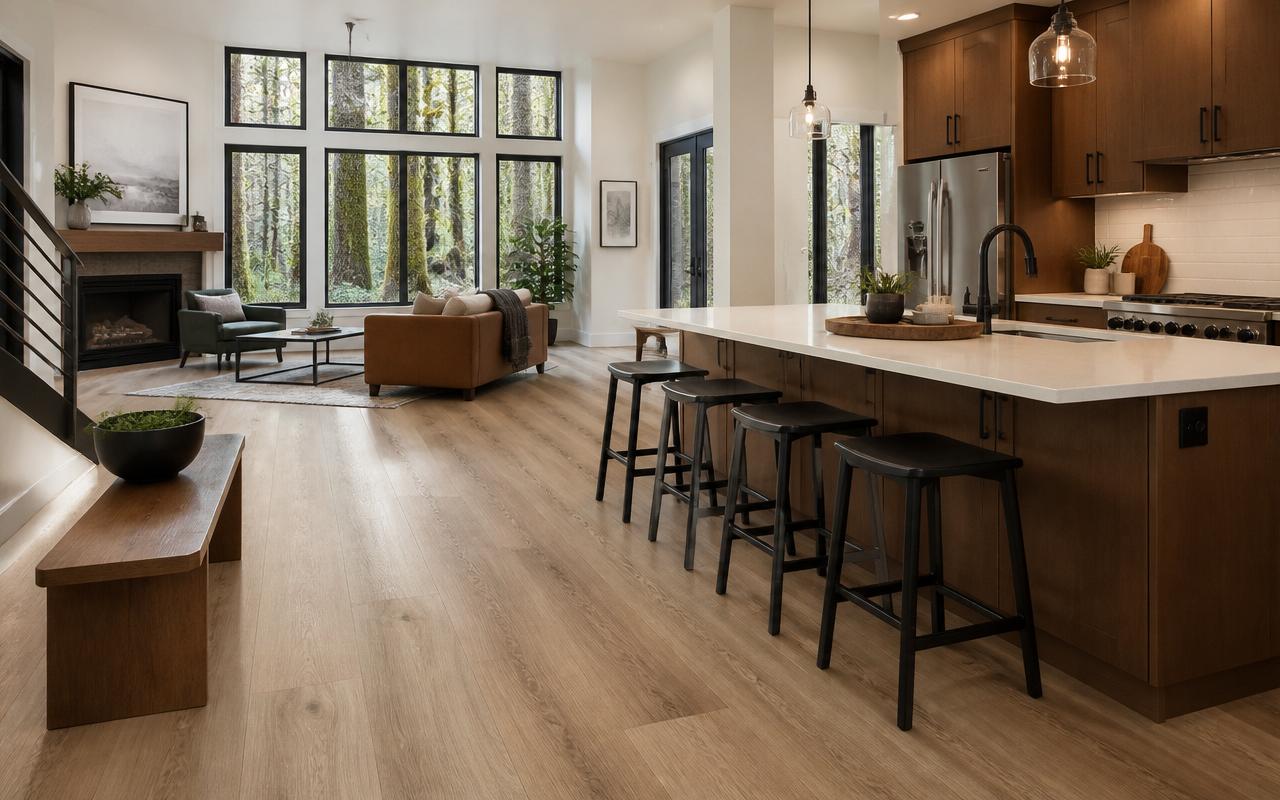
Five years ago, almost every Seattle remodel we quoted asked for engineered hardwood. In 2026, the conversation flips before the first site visit: "What do you think about SPC?" Stone-Plastic Composite click-lock vinyl has quietly become the default floor in Pacific Northwest kitchens, basement ADUs, rental rehabs, and even mid-tier whole-home remodels. Here's what's driving the shift, what it actually costs in King and Pierce counties this year, and the spec details that separate a 10-year floor from a 2-year mistake.
Why SPC took over the Puget Sound remodel market
Three trends collided. First, basement ADU and DADU permits in Seattle hit record volume — and every one of those units needs a waterproof, code-friendly floor over concrete. Second, engineered hardwood prices climbed 18% since 2023 while quality dropped (thinner veneers, more warranty exclusions for humidity). Third, the latest generation of 20-mil SPC genuinely looks like white oak or rift-cut walnut — not the plasticky planks of 2018.
Add Seattle's moisture profile (chronic 70%+ humidity from November through April), aging subfloors in Ballard, West Seattle, and Tacoma's North End, and the rise of rental conversions, and SPC checks every box: waterproof, dimensionally stable, fast to install, and friendly to uneven old joists.
SPC vs LVP vs laminate vs engineered hardwood — 2026 Pacific Northwest comparison
Torn between the vinyl and laminate families specifically? LVP vs laminate: the full comparison walks the room-by-room decision from a Seattle perspective. Installing it yourself? Read the 7 installation mistakes that ruin floating floors first.
- SPC (rigid core vinyl): 100% waterproof, stable from 0–140°F, 20–30 year residential warranty, $5.50–$9.50/sf installed. Best for basements, kitchens, ADUs, rentals.
- LVP (flexible vinyl plank): waterproof but telegraphs subfloor flaws, softer underfoot, $4.50–$7.50/sf installed. Fine for budget rentals on flat subfloors.
- Laminate: the 2026 water-resistant lines are far better than the old stuff, and for above-grade living areas and bedrooms it's the value pick — see our laminate vs vinyl guide for Seattle homes. For basements, laundry rooms, or full bathrooms we still spec SPC.
- Engineered hardwood: beautiful and refinishable once or twice, but $10–$18/sf installed and voids warranty in most basements. Still our pick for high-end main floors above grade.
Real 2026 SPC project costs from Seattle & Tacoma
- Ballard basement ADU (640 sf, 7 mm SPC, 20-mil wear, self-leveler over slab): $6,850 installed → $10.70/sf all-in including moisture prep.
- Tacoma North End kitchen + great room (820 sf, 6.5 mm SPC, 22-mil): $6,150 installed → $7.50/sf.
- Bellevue rental rehab (1,420 sf whole unit, 5 mm SPC, 12-mil): $8,520 installed → $6.00/sf.
- West Seattle DADU (480 sf, 8 mm SPC with attached IXPE pad, radiant-ready): $4,950 installed → $10.30/sf.
The spec sheet that separates a good floor from a callback
- Wear layer ≥ 20 mil for full-time households, pets, or rentals. 12 mil is the bedroom-only floor.
- Core thickness ≥ 5 mm (6.5–8 mm for uneven Craftsman subfloors).
- Attached IXPE underlayment for sound dampening — required by most Seattle condo HOAs.
- Bevel edge with deep emboss for a convincing wood look in Pacific Northwest daylight.
- Floor Score or Greenguard Gold certification for low VOC — essential in tight, well-sealed Pacific Northwest homes.
- Manufacturer-rated for radiant heat if you're pairing with in-floor heating in a bathroom or basement.
Installation mistakes that fail SPC in Seattle homes
- Skipping the moisture test. Every slab and crawlspace in the Pacific Northwest needs a calcium chloride or RH probe test. Skip it and the warranty is void.
- No expansion gap. SPC moves 1/4" per 30 linear feet with temperature swings. Tight reveals at walls cause buckling by August.
- Floating over tile without leveling. Grout lines fatigue the click joints — guaranteed separation within a year.
- Wrong transitions. T-molds belong at doorways > 30 feet of continuous run. Most installers skip them; we don't.
Brands we install across the Seattle–Tacoma area
We rotate between four SPC product lines based on budget, wear demands, and lead time: Mohawk RevWood Premier (mid), Shaw Floorté Plus (premium 22-mil), CALI Longboards XXL (wide-plank aesthetic), and COREtec Pro Plus (basement / rental workhorse). All four ship from Pacific Northwest distributors, so lead time is typically 5–10 business days — versus 6–10 weeks for most engineered hardwood lines.
Is SPC right for your Seattle remodel?
If your project is a basement ADU, kitchen, rental turnover, DADU, or full-floor remodel below the watertable, the answer is almost always yes. If it's a high-end main floor in a 1910 Capitol Hill craftsman and budget allows, engineered hardwood still wins on resale. For everything in between — which is most of what we build in 2026 — SPC click-lock is the floor that disappears into the background and just works through a Pacific Northwest winter.
Quick answers: SPC Click Vinyl Flooring in Seattle & Tacoma 2026
These 6 answers cover the questions Seattle, Bellevue, Tacoma and Kent homeowners ask most about this project — cost ranges, permits, and how long the work takes; all figures come from the published planning bands we quote on King and Pierce County projects in 2026.
- What is SPC flooring and how is it different from LVP?
- SPC (Stone Plastic Composite) is a rigid-core vinyl plank built around a limestone-and-PVC core, with a click-lock edge and a printed wear layer on top. Compared to flexible LVP, SPC is denser, dimensionally stable, 100% waterproof, and tolerates Seattle's humidity swings and uneven 1920s subfloors without telegraphing imperfections.
- How much does SPC click-lock vinyl flooring cost installed in Seattle in 2026?
- Installed SPC in the Seattle–Tacoma area runs $5.50–$9.50 per square foot in 2026. Material is typically $2.80–$5.20/sf for 5–7 mm planks with a 20-mil wear layer; labor including underlayment, trim, and disposal is $2.50–$4.30/sf. Basement ADU installs trend higher due to moisture prep and leveling.
- Is SPC flooring good for Seattle basements and ADUs?
- Yes — SPC is the default basement flooring in our DADU and basement ADU builds. It is fully waterproof, works directly over concrete with a 2 mm IXPE pad, and meets King County rental code for moisture-resistant finishes. Pair it with a vapor barrier and a properly drained perimeter and it outperforms engineered hardwood in Pacific Northwest below-grade conditions.
- What wear layer should I buy for a Seattle family home?
- For full-time households, dogs, or rentals: 20-mil wear layer minimum. Light-traffic primary bedrooms can drop to 12 mil. Anything under 6 mil is builder-grade and will scratch within a year — skip it. Pacific Northwest grit from gravel driveways and trail shoes is brutal on thin wear layers.
- Can SPC flooring go over radiant floor heat?
- Yes — most major SPC brands are rated for radiant systems up to 81°F (27°C) surface temperature. Confirm the SPC product's TOG rating and stay within the manufacturer's ramp-up curve to avoid joint separation.
- Does SPC flooring work over old Seattle hardwood or tile?
- Yes, when the substrate is flat to within 3/16" over 10 feet. Most pre-1940 Seattle and Tacoma homes need a self-leveling compound or 1/4" plywood underlayment first. We never float SPC directly over cracked tile — the click joints fatigue and separate within a season.
Get a fixed price for your Seattle or Tacoma project
Four fields, about 30 seconds. We reply within 2 business hours, Monday–Friday 8am–5pm PT, and we work across King and Pierce counties — Seattle, Bellevue, Issaquah, Renton, Kent, Tacoma and the towns between them. Bathroom remodels here run $20,000–$50,000 over 4–8 weeks and tub-to-shower conversions $8,000–$30,000 over 1–3 weeks; your written estimate prices your actual room, with the exclusions spelled out.